

 Browse All News
New Jersey Future Releases Map of Lead Service Lines in New Jersey



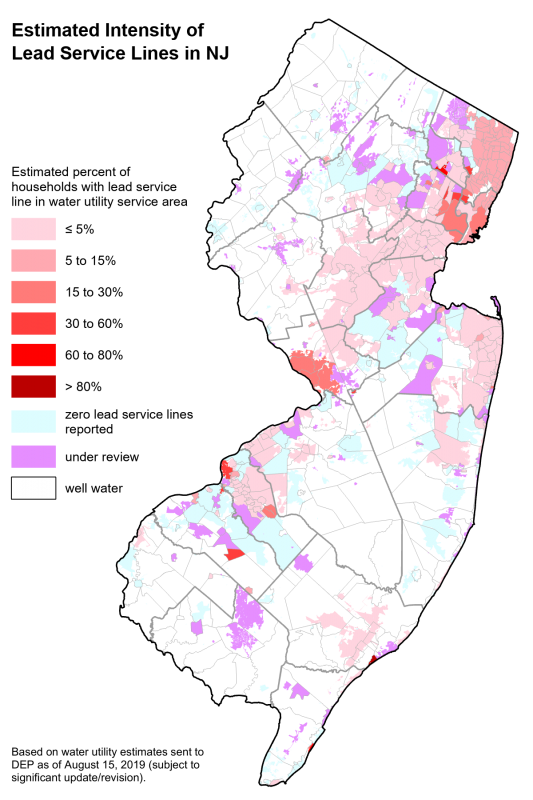
161,000 lead service lines found in 104 New Jersey water systems
New Jersey is confronting a public health problem as Newark deploys a massive effort to ensure safe drinking water through corrosion control efforts, the use of in-home filters, and lead service line replacement, but Newark is not the only community at risk.
Lead in drinking water is a statewide problem impacting communities in urban, suburban, and rural areas.
Lead service lines, the primary source of lead in drinking water, have been reported in 104 water systems as of August 2019, potentially exposing some portion of over 5 million residents who live in these service areas. Lead service lines are hose-sized pipes containing some amount of lead that connect water mains under the streets to buildings, but lead may also be present in pipes and plumbing in older homes, schools and other buildings.
“Lead exposure is a serious health threat across the state,” said New Jersey Future Managing Director of Water and Policy Chris Sturm. “These lead service lines have the potential to put everyone, particularly children and infants, at risk. Fortunately, this risk can be managed by effective corrosion control, flushing and filters, and ultimately by the total replacement of lead service lines.”
“Residents in areas showing the presence of lead service lines can contact their water utility to request results from water tests in their community, and if available, specific information about their property. They can also learn if other protective actions are recommended. Community results are also available on DEP’s Drinking Water Watch website,” Sturm said.
Data for the lead service line inventory is self-reported by water utilities to New Jersey’s Department of Environmental Protection (DEP) based on records and field operations, and as such is expected to change significantly as water systems identify additional lead service lines.
“In order to effectively and efficiently replace these lead service lines, comprehensive state legislation is needed,” said New Jersey Future Policy Manager Gary Brune. “The cost of replacement can be reduced by approximately 25% when entire neighborhoods are replaced at once compared to a scattered, house-by-house approach. This work can begin while the inventory is being refined, as preliminary locations can serve as a guide to ensure resources are allocated appropriately.”
At a press conference on October 10 at 2 pm in the State House Annex Committee Room 11, a task force convened by Jersey Water Works, a collaborative of diverse organizations focused on transforming New Jersey’s inadequate water infrastructure and of which New Jersey Future is a member, will be releasing a report of recommendations for the state to virtually eliminate lead in drinking water in 10 years.
Detailed mapping methodology can be found here
Related News Releases

11/06/2025

09/19/2025
09/03/2025
07/16/2025
07/07/2025

07/02/2025

05/07/2025
05/06/2025

04/24/2025

04/23/2025

04/16/2025
09/19/2024
06/22/2021
06/17/2021
06/11/2021
05/21/2021
05/20/2021
03/31/2021
02/23/2021
02/16/2021
02/04/2021
01/12/2021
12/21/2020
10/21/2020
09/18/2020
05/20/2020
04/17/2020
02/05/2020
02/05/2020
01/27/2020
01/14/2020
11/18/2019
10/29/2019
08/26/2019
06/10/2019
05/09/2019
04/09/2019
04/04/2019
03/26/2019
03/18/2019
03/05/2019
01/31/2019
01/28/2019
01/15/2019
01/14/2019
11/14/2018
11/05/2018
11/01/2018
10/23/2018
10/01/2018
09/12/2018
06/21/2018
06/18/2018
06/08/2018
06/08/2018
05/31/2018
05/17/2018
05/10/2018
04/12/2018
04/12/2018
04/10/2018
04/04/2018
04/03/2018
03/28/2018
03/13/2018
01/30/2018
01/26/2018
01/19/2018
01/16/2018
01/03/2018
11/30/2017